Introduction
“Bhaja govindam bhaja govindam
govindam bhaja müdhamate,
samprápte sannihite kále
na hi na hi rakshati dukrunkarane.”
Pray to the lord, think of him and meditate on him O fool! when the time for departure arrives, the repetition of grammar rules will not save you.
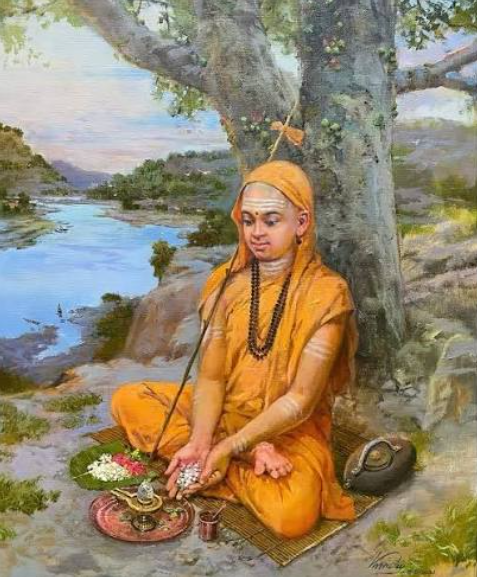
I a1m sure many of you have heard this song at least for once! Have not you? Until recently, I assumed it to be the song written by some saint or a poet belonging to the Vaishnava tradition. I did not this song was written by Adi Shanaracharya, the very Shiva who came down to the Earth to become Shankara and showed the world the essence of Sanyasa!
So for Bharath had witnessed many spiritual leaders but there are very few whose work and names reverberate in every other’s journey who has come after them. Adi Shankaracharya belongs to that list. He took birth in the times when the very Bharth which was the origin and hub of Vedic civilization and Sanatana Dharma was on the verge of being lost due to the influence of many indigenous and heretic tantric cultures who kept on promoting negative philosophies which led the society to take a moral plunge. Though, he lived only for 32 years, with in that time frame, he managed to review the entire Bharath’s culture and laid a strong foundation of Santana Dharma once again after winning every philosophical argument and debate with the opponents of divided sects and indigenous sects that he met on his mission to unite the entire country. He also founded a foolproof Sanaysa system known as Dashanami system to make people align themselves with monastic order and protected them from prevailing tantric lineages and their influences. All did it all by taking a huge risk of going against the left-hand tantric systems that eventually cost his physical health and energies.
Birth, Family and Childhood.
Adi Shanakaracharya was born to a Nambudari Brahman couple named Siva Guru and Aryamba in the month of May at Kalady village near Ernakulam, Kerala. In his early child hood itself he received education in Sanskrit. He lost his father at the age of 7 and later, the mother took over his up bringing and sends to Gurukul to receive Vedic education. Being a child prodigy, Shankaracharya grasped everything super quickly and receives appreciation from all elderly scholars. Soon, his reputation spreads across the different parts of the country and kingdoms. Many kings started to offer him a position in his kingdom and great deal of wealth. But being the avatara of lord Shiva himself, renunciation streak was ever active in him. He rejected all of them, and lived as a true Shiva or Sanyasi and followed begging for his food.
He was not just logically oriented vedic scholar but a compassionate human being who blessed many suffering souls and released them from the karmic knots. One such incidence is related to the origin of Kanakadhara Stotra. One day when the young sanyasi Shankar goes Infront of a home to beg for food, he encounters a poor lady with guilt in her eyes (of her inability to provide any other food to him) handing him a gooseberry in his begging bowl while uttering the words “karatalamalaka” – a phrase used to emphasize someone as a master or have achieved master on something. In the context, she wished Adi Shankaracharya “may your self -knowledge shine like the gooseberry that she offered to him.” Like Gooseberries which shine brightly in the presence of the Sunlight due to their translucent pulp, let the wisdom of the self-shines through you without any obstruction or negativity. Touched by the poor lady’s gesture and generosity, Adi Shankaracharya creates Kanakadhara Stotra – a prayer offered to Goddess Mahalakshmi relieve the woman out of her poverty. As a result, goddess rains golden gooseberries on the woman. As swami Mukhyananda writes in his book “Sri Shankaracharya Life and Philosophy” , the poor woman was none other than goddess Sarasvati and “the incident is interpreted to symbolize the Shankara to work for the resuscitation of the twofold Vedic Dharma consisting of – Abhyudhaya – Secular welfare and Nihshreyasa – Spiritual Summum Bonum. Like any spiritual leader that have attended their call from Dharma, he too realized the necessity to dedicate his life and sacrifice it for the welfare of the society and the country.
At the age of 16, after consoling his mother he would come back and would stay with her when she needs him at her last hours, he leaves his home on his Vijaya Yatra. The yatra he took when there were no roads, no means of transportation but solely and completely pada yatra (walk). He walked through the lengths and breadths of Bharath, reviewed traditions, united them as one sect after winning the opponents in the religious and spiritual debates. The main halting places were Omkareshwara, Varanasi, Kanci, Sringeri and Kashmir. At Omkareshwara, he goes to Sri Govindabhagavatpada and receives diksha to study Advaita Philosophy as his disciple. After 4 years of remaining as the shishya, he ventures out and reaches the famous spiritual centre of Bharath, Varanasi. In those days, if someone wanted to teach anything related to spirituality which they had realised or discovered they needed to prove their credentials in Varanasi first. Soon Shankara started to get followers and disciples. The main disciciples – Padmapada, Hastamalaka and Totaka joined Shanakra’s lineage in Varanasi.
Work:
Adi Shanakracharya has written commentaries on many scriptures. On an average, he wrote around 153 books that includes all – Bhasyas, Updadesha and Stuti Stotras. The most popular ones are Vivekachudamani, Govindastaka, Ananda Lahari, Soundarya Lahari Nirvana Shataka, Bhaja Govindam etc., He used Advaita to unite the different sects and established 4 major mathas in the 4 cardinal directions to carry on his mission – to establish vedic way of life which focuses on both material welfare of all in the society and spiritual progression of everyone. He made his disciples as the chief of each of these mathas. These 4 were Badrinath in the Northern Part/Himalayas, Puri in the East/Orissa, Dwaraka in the west, and Sringeri in the South.
He also established the 5th one in Kanchi. I personally understand, establishing Kanchi Peeta was crucial in order to establish the Vedic way of life. In the scriptures, Kanchi holds a great significance in terms of being midpoint of the planet Earth. The place which cuts away the past and makes way to the new. The word Kanchi means Scissor hence symbolising the cutting away of Karmic past and creating new future (which the navel symbolises spiritually). It was Adi Shankaracharya, who understood the essence of establishing Kanchi Kamakoti Peeta and consecrating the goddess Parvati in the form of wish full filling goddess and Sri Yanta to alleviate the society holistically. The story says, he brought down the goddess Parvati who was burning fire from the astral dimensions to the earthly plane, and calms her down through praises and consecrates him as the compassionate mother who fulfils everyone’s wish who seek refuge in her. This was crucial in order to fix the societies way in which tantric and heretic tribes worshiped the demi gods and tantric deities and were taking undue wealth from the society without which, the Vedic ways would not have been reestablished. And only Shiva can bring down the burning Parvati energy and calm her and transform her into a compassionate mother by being a Sanyasi which is what Adi Shankara was. It’s here he composed Lalita Trishati. He reviewed many temples especially 108 Divya Desam. Finally, he attained Mahasamadhi in Kedaranath.
Guru Shishya Parampara.
Did you know? It was Adi Shankaracharya who created the system of Guru Paduka Worshp as a token of reverence to his guru Govindabhagavadpada? He created Guru Paduka Stotra which is extensively been used in every Guru Paduka Worship regardeless of their allignment with vedic life style.
In total, Adi Shankaracharya founded 5 mathas and 10 sannyasa orders. So, today all of these mathas Dwaraka, Badrinath, Shringeri, Puri and Kanchi follow the footsteps of Adi Shankaracharya. The 10 Sanaysa orders/Spiritual ladders are extensively followed and integrated in the lives by everyone aligned with the 5 mathas established by Shankaracharya. They are Aranya, Ashrama, Bharati, Giri, Parvata, Puri, Sarasvati, Sagara, Tirtha, and Vana. In the next article, we will explore more on this topic.
- Photo Source: Google
↩︎